
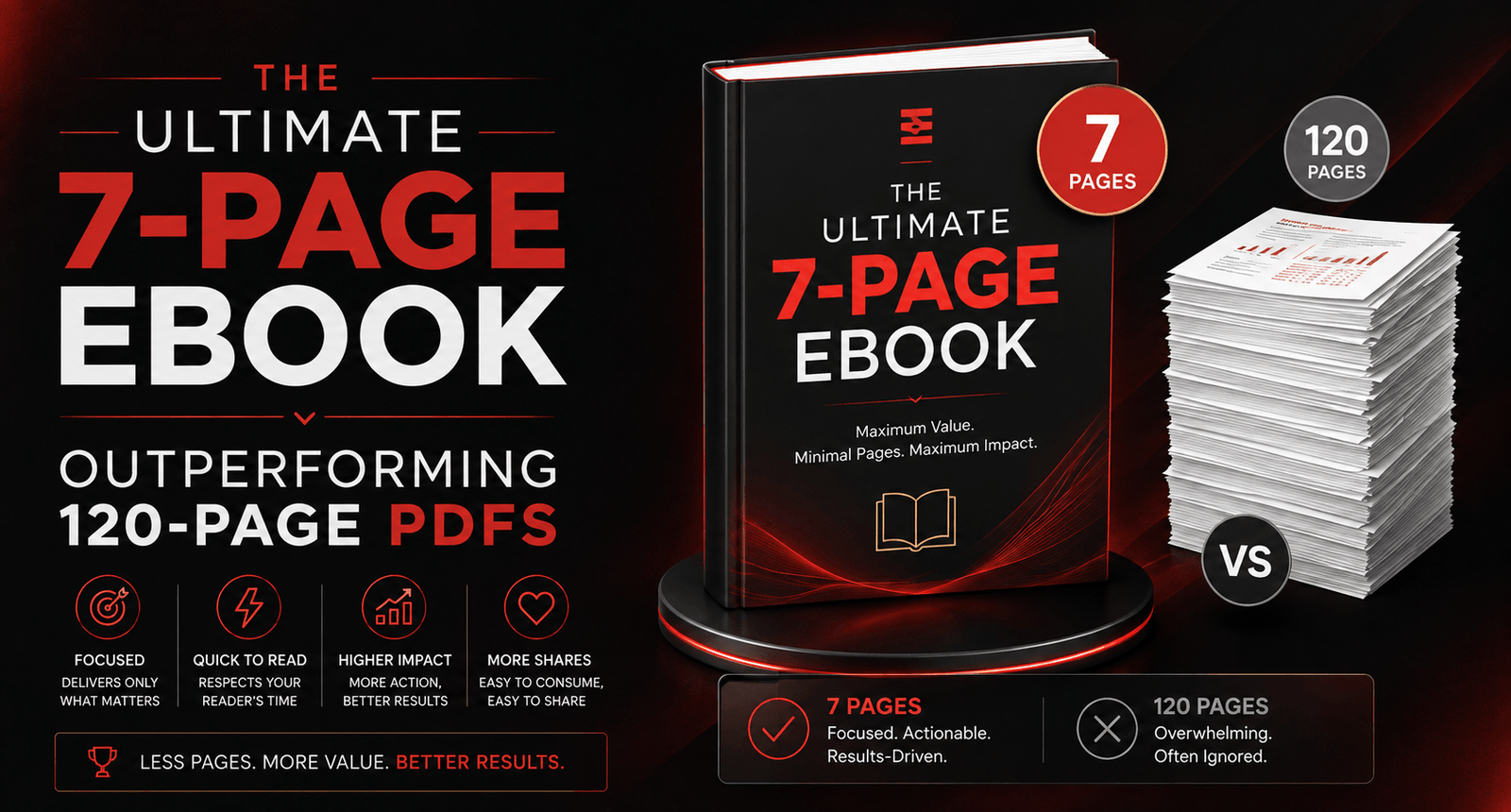
The Ultimate 7-Page Ebook: Outperforming 120-Page PDFs
So, you want to know if a 7-page ebook can really outperform a 120-page PDF? The short answer is a resounding “yes,” and it’s not just about brevity. It’s about strategic brevity, clear value, and understanding how people actually consume information these days. We’re talking about a paradigm shift in content consumption, where less often genuinely means more, especially when “less” is packed with punch.
Why Shorter is Often Better: The Modern Attention Span
Let’s be real. How many 120-page PDFs have you actually read cover-to-cover recently? Probably not many. Our digital lives have conditioned us for quick, digestible information. We skim, we scan, we jump around. A lengthy document, no matter how well-researched, often feels like a commitment many people aren’t willing to make.
- Information Overload: We’re bombarded with content every single day. A huge PDF can feel like another burden rather than a helpful resource.
- Time Constraints: People are busy. They want answers and solutions now, not after an hour of reading.
- Mobile-First Mentality: Reading a long PDF on a phone is a nightmare. Small screens, endless scrolling – it’s a recipe for abandonment.
The Power of Focus: What Makes a 7-Page Ebook Shine
It’s not just about cutting down word count; it’s about refining your message to its purest, most potent form. A 7-page ebook forces you to be ruthless with what stays in and what goes out.
- Clarity of Purpose: Every sentence, every paragraph, must serve a clear objective. There’s no room for fluff or tangential thoughts.
- Direct Value Proposition: You’re delivering a specific solution or insight without burying it under layers of preamble. Readers know exactly what they’re getting and why it matters.
- Actionable Insights: Short ebooks often focus on practical steps or key takeaways, making them highly actionable.
Creating an effective 7-page ebook isn’t about writing less; it’s about strategic writing. It’s about precision, impact, and understanding your audience’s needs.
Defining Your Niche and Core Message
Before you even think about writing, you need to know exactly what problem you’re solving or what value you’re providing. This is the bedrock of your ebook’s success.
- Identify Your Target Audience: Who are you writing for? What are their pain points, questions, and aspirations? The more specific, the better. Knowing your audience helps tailor the language, examples, and solutions. For instance, an ebook for small business owners about email marketing will have a different tone and focus than one for corporate marketing executives. Understanding their current knowledge level is also key – are they beginners, intermediate, or advanced? This informs how much foundational information you need to include (or exclude).
- Pinpoint a Single, Powerful Idea: What’s the one thing you want your readers to take away? A 7-page ebook thrives on focus. Don’t try to cover everything. Instead, pick a specific problem and offer a specific solution. For example, instead of “The Ultimate Guide to Digital Marketing,” aim for “3 Actionable Strategies to Double Your Email Open Rates.” This singular focus makes the ebook feel more digestible and achievable.
- Outline Your Value Proposition: Clearly state what the reader will gain from reading your ebook. Is it a shortcut, a new skill, a solution to a nagging problem? Make this explicit early on. This isn’t just about listing benefits; it’s about connecting those benefits directly to your audience’s desires. “Learn to build a basic website in under an hour” is a strong value proposition because it offers a tangible outcome within a specific timeframe.
Structuring for Maximum Impact
Think of your 7 pages as a finely tuned machine, each part contributing to the overall outcome. You need a logical flow that guides the reader seamlessly from problem to solution.
- Page 1: The Hook and Promise:
- Irresistible Title: Needs to grab attention and clearly state the benefit. Use numbers, strong verbs, and target keywords. “Unlock Your Creativity in 7 Days” is more compelling than “Thoughts on Creativity.”
- Problem Statement: Immediately articulate the problem your audience is facing. Make them feel understood. This builds rapport and demonstrates empathy. “Are you tired of feeling stuck with writer’s block?” is more effective than a generic introduction.
- The Big Promise: What specific, tangible outcome will they achieve by the end of these 7 pages? Be bold, but realistic. “By the end of this ebook, you’ll have a clear, actionable plan to overcome writer’s block and start producing compelling content.”
- Pages 2-6: The Core Content – One Idea Per Page (Roughly):
- Break Down Complexities: Each page (or two) should tackle a distinct, manageable step or concept related to your big promise. Avoid cramming too much information into one section.
- Use Subheadings and Bullet Points: Enhance readability and allow for easy skimming. People absorb information better in bite-sized chunks. Think about how you read articles online – you often scan headings first.
- Illustrative Examples: Concrete examples make abstract concepts easier to grasp. Show, don’t just tell. If you’re talking about effective headlines, provide good and bad examples.
- Actionable Advice: Every section should ideally lead to a practical step the reader can take. What should they do with this information? This transforms theoretical knowledge into applied learning. For instance, after explaining a concept, you might include a “Try This:” section with a specific exercise.
- Page 7: Call to Action and Next Steps:
- Recap Key Learnings: Briefly reiterate the main takeaways to reinforce the value. This helps solidify the information in the reader’s mind.
- Clear Call to Action (CTA): What do you want them to do next? Sign up for your newsletter, visit your website, book a consultation, purchase a product? Make it singular and undeniable. Don’t offer too many choices, as this can lead to indecision. “Click here to download your free template” is much better than “Check out my website, join my group, or follow me on social media.”
- Provide Further Resources (Optional but Recommended): A link to a blog post, a video tutorial, or a larger course can be a natural next step for engaged readers. This can subtly guide them deeper into your ecosystem.
In the digital age, the effectiveness of content delivery can significantly impact audience engagement and retention. A fascinating article that explores this concept is titled “The 7-page ebook that outperforms a 120-page PDF.” It delves into the reasons why concise and well-structured content can often yield better results than lengthy documents. For more insights on this topic, you can read the article here: The 7-page ebook that outperforms a 120-page PDF.
Content, Not Fluff: Maximizing Every Word
Every word in a 7-page ebook needs to earn its keep. There’s no room for filler, jargon, or unnecessary explanations.
In today’s fast-paced digital landscape, the effectiveness of concise content is becoming increasingly evident, as highlighted in a related article that discusses how a 7-page ebook can outperform a lengthy 120-page PDF. This article emphasizes the importance of brevity and engagement in capturing the audience’s attention, making it essential reading for anyone looking to enhance their content strategy. For more insights on this topic, you can check out the full discussion in this related article.
Writing with Precision and Clarity
This is where you become a content surgeon, trimming away anything that doesn’t add direct value.
- Concise Language: Avoid long, convoluted sentences. Get straight to the point. Replace phrases like “due to the fact that” with “because.” Remove adverbs that don’t add significant meaning.
- Eliminate Jargon: Write for your audience, not for your peers. If you must use industry-specific terms, explain them briefly. Assume your reader is intelligent but not necessarily an expert in your specific niche.
- Strong Verbs and Active Voice: Makes your writing more dynamic and engaging. Instead of “Mistakes were made,” say “We made mistakes.”
- Focus on Benefits, Not Just Features: Don’t just describe what something is; explain what it does for the reader. For example, instead of “Our software has a powerful analytics dashboard,” say “Our software helps you quickly identify your most effective marketing campaigns.”
Integrating Visuals Wisely
Visuals aren’t just pretty pictures; they’re powerful communication tools that can convey complex ideas quickly and break up text.
- Purposeful Imagery: Every image, chart, or infographic should serve a specific purpose: to explain a concept, illustrate a point, or break visual monotony. Don’t just drop in stock photos for the sake of it.
- Simple & Clean Design: Avoid cluttered graphics. Clear labels, legible fonts, and a consistent color scheme are key.
- Data Visualization: Use charts and graphs to present data in an easily digestible format. A well-designed bar chart can convey more information than a paragraph of text.
- Screenshots/Diagrams for Processes: If you’re explaining a step-by-step process, screenshots or simple diagrams are invaluable. They reduce ambiguity and make instructions easier to follow.
Distribution and Measuring Success

A brilliant ebook is only half the battle. Getting it into the hands of your audience and understanding its impact is crucial.
Smart Distribution Strategies
You’ve put in the work; now make sure your ebook gets seen by the right people.
- Your Website/Blog: This is your home base. Create a dedicated landing page with a compelling description and a clear call to action to download.
- Email List: Your existing subscribers are your warmest audience. Announce the ebook with enthusiasm and a direct link. Consider offering it as an exclusive freebie for new subscribers.
- Social Media Promotion: Share snippets, key takeaways, and testimonials on platforms where your audience hangs out. Don’t just post once; schedule multiple posts over time. Use relevant hashtags.
- Guest Blogging/Partnerships: Offer your ebook as a lead magnet for a guest post on a complementary blog. Collaborate with other businesses or influencers for cross-promotion.
- Online Communities/Forums: If appropriate, share your ebook in relevant online groups (e.g., LinkedIn groups, Facebook groups, Reddit subreddits) where your target audience actively seeks solutions. Be mindful of group rules regarding self-promotion.
- Paid Advertising (Optional): If your ebook is a high-value lead magnet for a significant product or service, consider running targeted ads on platforms like Facebook, Instagram, or LinkedIn.
Analyzing Performance and Iterating
Don’t just release it and forget it. Understanding how your ebook performs helps you refine your strategy.
- Track Downloads: This is your primary metric. How many people are actually downloading it?
- Conversion Rates: If you’re using it as a lead magnet, what percentage of landing page visitors are converting into downloads (and then into leads or customers)?
- Feedback (Direct and Indirect): Are people talking about it? Are you getting questions related to its content? Are you seeing an uptick in engagement on your other content related to the ebook’s topic?
- Website Traffic Referrals: Where are the downloads coming from? This helps you understand which distribution channels are most effective.
- Iterate and Improve: Based on your analytics, don’t be afraid to tweak your landing page copy, promotional messages, or even the ebook content itself if you identify areas for improvement. Maybe a different call to action would convert better, or a slight rephrase of your promise could resonate more.
The 7-page ebook isn’t just a trend; it’s a smart, audience-centric approach to content creation. It respects your reader’s time, delivers focused value, and positions you as a helpful expert. By embracing brevity and strategic content, you can indeed create something that outperforms its longer, more cumbersome counterparts every single time. It’s about delivering maximum impact with minimal commitment, and that’s a winning formula in today’s digital landscape.