
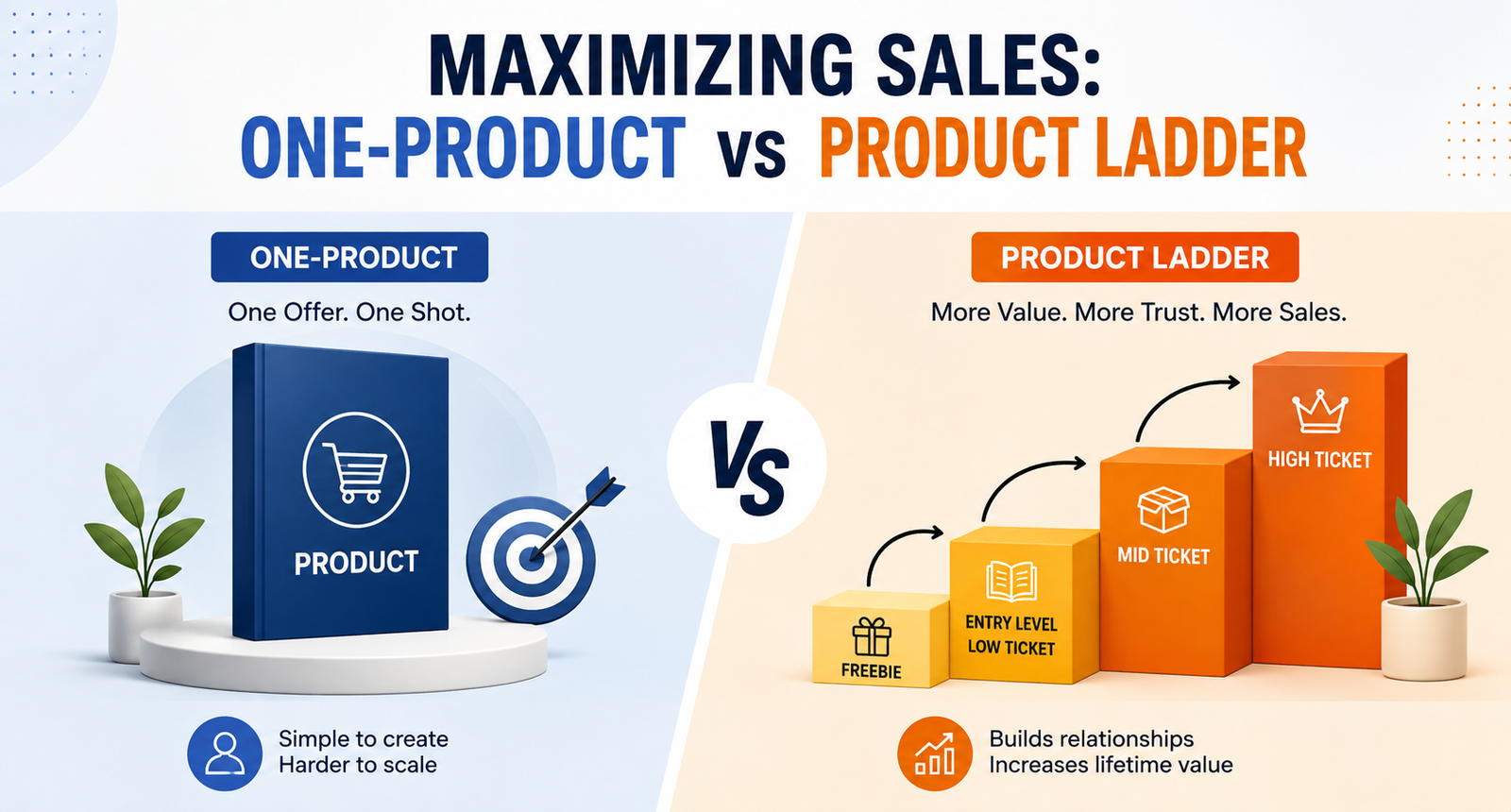
Proven Ways to Maximize Sales: One-Product vs Product Ladder
In Maximizing Digital Product sales, let’s get straight to it. This depends on your business goals, target audience, and the nature of your offering. There is no one-size-fits-all answer. Understanding the strengths and weaknesses of each approach helps you decide.
ConvertNest works for both. You can run a full ladder, with a lead magnet, low-ticket items, a core product, and upgrades. It operates without switching tools as your catalog grows.
The One-Product Approach: Simplicity and Focus
The one-product model is exactly what it sounds like: your business centers around a single, core offering. This approach can be incredibly powerful when executed well, especially for startups or businesses with a very clear niche.
The Appeal of Focus
- Clarity for Customers: When you only offer one product, there’s no confusion for your customers. They know exactly what you do and what problem you solve. This can lead to a more straightforward marketing message and a clearer brand identity.
- Streamlined Operations: Managing inventory, production, marketing, and customer service becomes much simpler with a single product. You can dedicate all your resources and attention to perfecting that one item.
- Mastery and Specialization: By focusing on one product, you have the opportunity to become an absolute expert in that specific area. This expertise can translate into a superior product, more effective marketing, and a reputation for excellence.
- Easier Market Entry: For new businesses, launching with one product can be less daunting and require fewer resources than trying to develop and market multiple offerings simultaneously.
When a Single Product Shines
- Highly Specialized Niche: If your product serves a very specific, well-defined need, a single-product approach can be highly effective. Think of a software tool designed for a particular industry, or a unique physical product that solves a singular problem.
- High-Value, High-Profit Item: If your single product commands a high price point and offers significant profit margins, you might not need a broad product line to achieve your revenue goals. Luxury goods or complex B2B solutions often fall into this category.
- Scalable Service: For service-based businesses, a “one-product” approach might translate to offering a single, highly specialized service. For example, a consulting firm that focuses exclusively on SEO for e-commerce businesses.
- Building Brand Recognition: Some iconic brands started with one killer product and built their reputation around it before expanding. Think of the early days of Coca-Cola or Apple (with the Macintosh).
If that’s you, ConvertNest is built for that kind of focus: one product, one popup, one checkout path. You’re not forced into a multi-offer catalog just because the platform can support one.
Potential Drawbacks of a Single Product
- Limited Revenue Streams: Relying on one product means all your eggs are in one basket. If demand for that product declines or a competitor emerges, your business is highly vulnerable.
- Difficulty in Upselling/Cross-selling: Without other products, you miss opportunities to increase the average transaction value per customer.
- Market Saturation Risk: Once your core market is saturated, growth can become challenging unless you continually innovate or find new markets for your single product.
- Less Customer Lifetime Value (CLV): While you might acquire customers effectively, without additional offerings, their long-term value might be capped after their initial purchase.
In the discussion of the effectiveness of a single product versus a product ladder, it’s interesting to consider how a streamlined approach can often outperform a cluttered catalog. For further insights on this topic, you can check out a related article that delves into the benefits of simplicity in product offerings.
The Product Ladder: Guiding Customers Upwards
A product ladder, also known as a value ladder or product ecosystem, involves offering a range of products or services at different price points and value levels. The idea is to attract customers with a lower-cost, entry-level offering and then guide them towards higher-value, higher-priced products over time.
The Strategy Behind the Ladder
- Attracting a Wider Audience: Lower-priced products can serve as an accessible entry point for customers who might be hesitant to commit to a more expensive offering upfront.
- Building Trust and Relationships: A positive experience with a lower-tier product can build trust and rapport, making customers more receptive to purchasing higher-tier items later.
- Maximizing Customer Lifetime Value (CLV): By continually offering relevant, upgraded solutions, you can significantly increase the total revenue you generate from each customer over their relationship with your business.
- Diverse Revenue Streams: A product ladder diversifies your income, making your business more resilient to fluctuations in demand for any single product.
- Addressing Varied Customer Needs: Different customers have different budgets and requirements. A product ladder allows you to cater to a broader spectrum of needs within your target market.
Components of a Typical Product Ladder
- Free Offer/Lead Magnet (Bait): This is often a free resource like an ebook, webinar, free trial, or consultation. Its purpose is to attract leads and capture their contact information.
- Low-Ticket Offer (Entry Point): A relatively inexpensive product or service that provides immediate value and solves a specific, small problem. This is where most initial customer relationships begin. Examples include a mini-course, a small tool, or a single-session service.
- Mid-Ticket Offer (Core Solution): This is often your main product or service, providing a more comprehensive solution to a significant problem. It represents a substantial investment for the customer.
- High-Ticket Offer (Premium Solution/Transformation): Your most expensive and often most impactful offering. This could be a comprehensive coaching program, a high-end software package, done-for-you services, or a luxury version of your core product.
- Continuity/Subscription Offer (Ongoing Value): Products or services that provide recurring revenue, such as membership sites, subscriptions, or ongoing support plans. These foster long-term customer relationships.
ConvertNest can run that full ladder in one place: a free lead magnet popup, a low-ticket digital product, your core offer, and higher-ticket upgrades—each with its own funnel, without leaving the same product and popup workflow.
When a Product Ladder Excels
- Complex Problem-Solving: If your business addresses multifaceted customer problems that require different levels of support or solutions, a product ladder is ideal. For instance, helping someone with their fitness journey from beginner to advanced.
- Building Long-Term Relationships: Businesses that thrive on repeat customers and ongoing engagement benefit greatly from a product ladder, as it provides a natural progression for customers to stay involved.
- Service-Based Businesses: Coaching, consulting, agencies, and educational platforms are prime candidates for product ladders, offering everything from free guides to intensive, high-end programs.
- Digital Products: E-courses, software, templates, and subscription content can easily be structured into a product ladder, allowing for various entry points and upgrade paths.
- Physical Products with Accessories/Upgrades: Think of a camera brand offering different models, lenses, and accessories, or a coffee company selling beans, grinders, and brewing equipment.
Potential Drawbacks of a Product Ladder
- Increased Complexity: Managing multiple products, price points, marketing messages, and customer journeys can be significantly more complex than focusing on one item.
- Resource Intensive: Developing and supporting a full product ladder requires more time, money, and personnel.
- Potential for Customer Confusion: If the ladder isn’t clearly structured and communicated, customers might get lost or overwhelmed by the options.
- Risk of Neglecting Core Offerings: Spreading resources too thin across many products can lead to none of them being truly exceptional.
Hybrid Approaches and Evolving Strategies
It’s important to remember that these aren’t mutually exclusive, fixed strategies. Many successful businesses start with a strong single product and then gradually build out a product ladder around it as they grow and understand their customers better.
That’s also how ConvertNest is meant to be used: start with one product if that’s all you need, then add the next rung—another product, another popup, another offer—when you’re ready. You don’t have to pick a “single-product tool” or a “ladder tool.” Same platform, both cases.
Starting Small, Growing Big
- Launch with One, Plan for More: You can begin with a single, excellent product to gain traction and establish your brand. As you gather customer feedback and data, you can then strategically introduce complementary products to build out your ladder.
- Identify Natural Extensions: Look for pain points or desires that naturally arise after a customer has used your initial product. These are prime candidates for new additions to your ladder.
- Test and Iterate: Don’t feel pressured to launch a full product ladder all at once. Introduce new offerings one by one, test their market viability, and refine your strategy based on actual results.
Leveraging Add-ons and Bundles
- One Core, Many Enhancements: Even if you primarily focus on one core product, you can still increase sales by offering optional add-ons, premium features, or service packages. This acts like a mini-ladder within your single product.
- Strategic Bundling: Combine your core product with relevant complementary items at a slightly discounted price. This encourages customers to spend more than they initially intended.
The Critical Role of Your Customer
Regardless of whether you choose a one-product or product ladder approach, understanding your customer is paramount. Maximizing Digital Product sales should guide your strategy, ensuring offerings align with customer needs and motivations.
Knowing Your Audience’s Journey
- What are their pain points? Both initial and subsequent problems that your business can solve.
- What are their budget limitations? This helps determine appropriate price points for different tiers.
- What is their desired outcome? How can your products guide them towards achieving it?
- What is their level of commitment? Are they looking for a quick fix or a long-term transformation?
Communication is Key
- Clear Value Proposition: For each product, clearly articulate what problem it solves and the benefit it provides.
- Seamless Customer Journey: If you have a product ladder, ensure the progression from one tier to the next feels natural and logical to the customer.
- Targeted Messaging: Tailor your marketing messages for each product or tier to resonate with the specific audience segment it’s designed for.
In the ongoing debate between a single product offering and a more complex product ladder, insights from a related article can provide valuable context. The discussion highlights how a straightforward $47 file can outperform a cluttered catalog, emphasizing the importance of clarity in product presentation. For those interested in exploring this topic further, you can read more about it in this informative piece on ConvertNest. Understanding the nuances of product strategy can significantly impact sales and customer engagement.
Making the Right Choice for Your Business
To decide between a one-product strategy and a product ladder, ask yourself these questions:
Assessing Your Resources
- What is your budget for development and marketing? A product ladder requires more.
- What are your team’s capabilities? Can they manage multiple products and customer segments effectively?
- How much time do you have to launch and scale? A single product can often launch faster.
Understanding Your Market
- How large is your target market for a single product? Is there enough demand to sustain your business?
- Are there natural opportunities for upsells or cross-sells within your niche?
- How do your competitors approach their offerings? What can you learn from them, and how can you differentiate?
Defining Your Goals
- Are you looking for rapid, focused market penetration or sustained, long-term customer relationships?
- What’s your desired average customer lifetime value? A product ladder is often better for higher CLV.
- How much risk are you comfortable with? A single product can be riskier in terms of revenue stability.
Ultimately, the best approach is the one that aligns with your specific business context, allows you to serve your customers effectively, and provides a sustainable path to growth. Both strategies have merit, and many businesses find success by evolving from one to the other over time. The key is to be intentional, data-driven, and always focused on delivering value to your customers.
Whatever you choose—one hero product or a full ladder—ConvertNest can power the capture, popup, and delivery for both. Start simple, add rungs when it makes sense, and keep the customer journey as clear as the offer itself.