
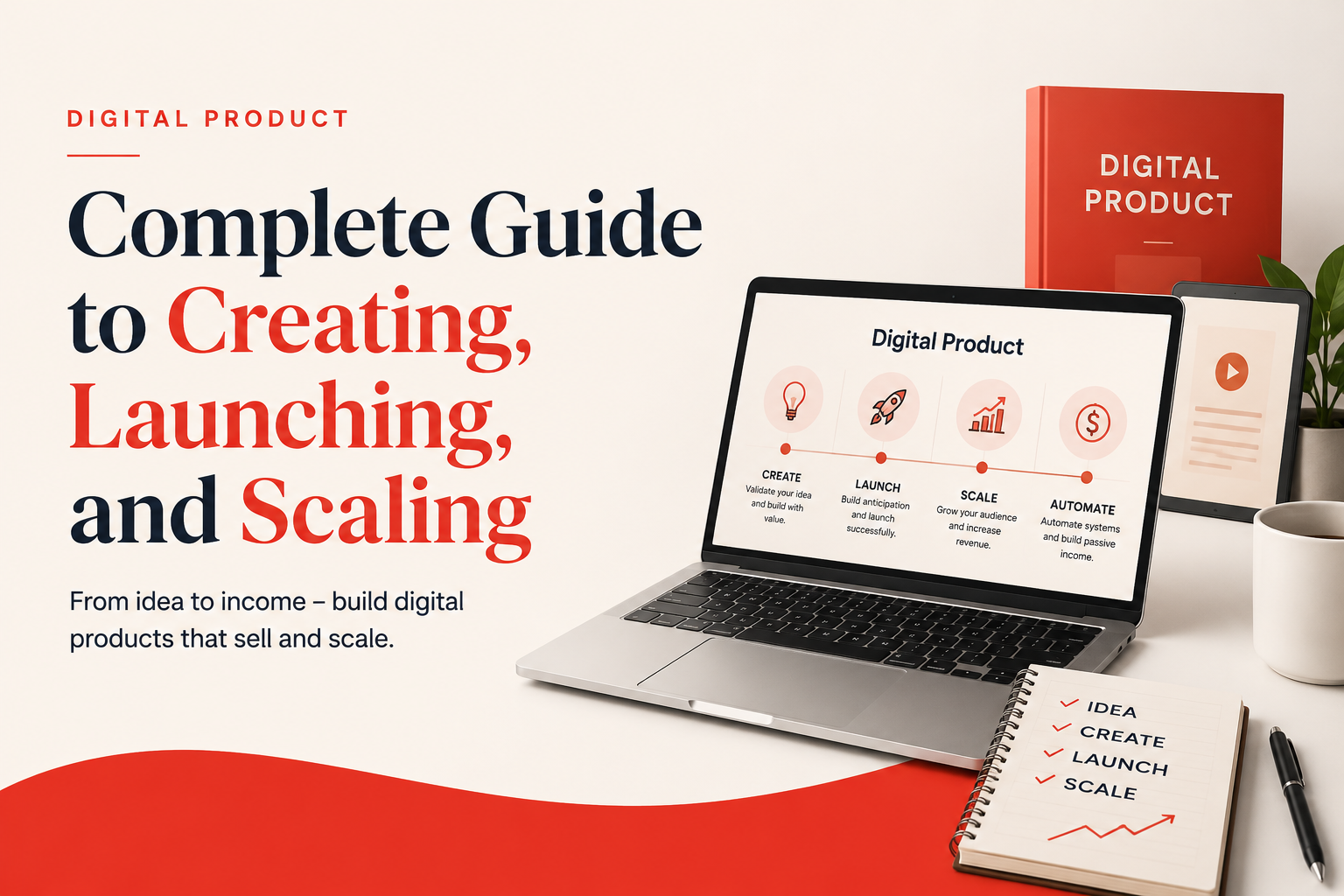
Digital Product: Complete Guide to Creating, Launching, and Scaling
Discover what a digital product is, why it’s one of the most scalable business models today, and how to build a profitable digital product from idea to growth.
What Is a Digital Product?
A digital product is any intangible good delivered electronically—examples include eBooks, online courses, templates, software, plugins, digital art, audio files, and membership content. Unlike physical goods, a digital product can be replicated with near-zero marginal cost, making it ideal for creators, freelancers, and businesses seeking passive revenue streams.
Why Sell a Digital Product?
Digital Product: How to Create, Launch, and Scale
Building a successful digital product starts with a strong idea and ends with consistent promotion and optimization. Whether you want to publish an eBook, launch an online course, sell templates, or distribute software, this guide helps you go from concept to recurring revenue.
Why Choose a Digital Product?
Digital products offer low overhead, instant delivery, and high scalability. Unlike physical goods, a digital product can be replicated infinitely at minimal cost, enabling margin-focused growth and flexible pricing strategies.
Top Digital Product Ideas
- eBooks and guides focused on niche problems
- Online courses and workshops
- Printable planners, templates, and design assets
- SaaS tools, plugins, and mobile apps
- Stock photos, icons, and digital art
Step-by-Step: Create Your First Digital Product
- Research demand: use keyword research, forums, and surveys to identify pain points.
- Validate quickly: create a landing page or a mini-course to test interest.
- Build an MVP: focus on core value and fast delivery.
- Set pricing: test multiple price points and consider tiered offers.
- Choose delivery: integrate with Gumroad, Shopify Digital Downloads, or a membership platform.
- Launch and iterate: collect feedback and improve features or content.
Marketing Strategies That Work
To convert visitors into buyers, combine content marketing, email funnels, and paid ads. Use SEO-optimized content around the term “digital product” to attract organic traffic. Offer free lead magnets, run webinars, and collaborate with influencers in your niche.
Pricing and Monetization
Consider one-time payments, subscriptions, or freemium models. Use A/B testing for pricing and offer bundles to increase average order value. For recurring revenue, convert a single digital product into a membership or SaaS offering.
Technical Setup Checklist
- High-converting landing page with clear value proposition
- Secure payment gateway and automated delivery
- Email autoresponder and onboarding sequence
- Analytics tracking for conversions and retention
- Backup and version control for digital assets
Frequently Asked Questions
Can I sell multiple types of digital products?
Yes. Diversifying—e.g., combining courses, templates, and coaching—helps broaden revenue streams and appeal to different customer segments.
How do I protect my digital product from piracy?
Use licensing, limited-access delivery, watermarking for media, and legal terms in your sales process. While piracy can’t be fully prevented, reducing friction for legitimate buyers increases conversions.
Ready to build your own digital product? Start by validating one idea this week and create a simple landing page to collect email interest. Get Started
- Low production and distribution costs
- High scalability and global reach
- Flexible pricing and recurring revenue options
- Fast iteration and updates
These advantages make a digital product attractive for solopreneurs, agencies, and enterprises aiming to diversify revenue.
Proven Steps to Build a Successful Digital Product
- Validate the idea: Use keyword research, surveys, social listening, and minimum viable offerings (freebies or beta access) to confirm demand for your digital product.
- Define the audience: Create buyer personas and outline pain points, desired outcomes, and purchasing behaviours specific to your niche.
- Design the solution: Map features, create a course curriculum, or draft templates. Focus on delivering measurable value and quick wins for users.
- Develop and package: Use tools like course platforms, PDF creators, app builders, or marketplaces to build your digital product. Prioritize quality, usability, and clear documentation.
- Set pricing and delivery: Test pricing tiers, subscriptions, and one-time payments. Decide delivery methods: direct download, membership access, or SaaS onboarding.
- Launch and market: Prepare landing pages, email campaigns, content marketing, paid ads, and PR to reach your target audience.
- Optimize and scale: Gather feedback, improve the product, add upsells or bundles, and expand distribution to platforms and affiliates.
SEO & Marketing Strategies for Digital Products
To increase visibility and conversions for your digital product, combine content marketing with technical SEO and conversion optimization:
- Keyword-focused content: Publish articles, tutorials, and case studies targeting long-tail phrases like “how to create a digital product,” “best digital product ideas for designers,” or “sell digital products on Shopify.”
- High-converting landing pages: Use clear headlines, benefit-driven copy, social proof, and a single, prominent call-to-action to convert visitors into buyers or leads.
- Lead magnets and funnels: Offer a free mini-version, checklist, or webinar to capture emails and nurture prospects with automated sequences.
- Partnerships and affiliates: Use influencers and affiliate programs to expand reach and reduce customer acquisition costs.
- Analytics and A/B testing: Track conversions, onboarding completion, and churn to refine messaging, pricing, and features.
Pricing Models for Digital Products
Choose a pricing model that fits your product and audience:
- One-time purchase: Works well for eBooks, templates, and courses.
- Subscription/SaaS: Ideal for software, ongoing content, and membership sites.
- Freemium: Offer a basic free tier and paid upgrades.
- Tiered pricing: Provide multiple levels with increasing value and features.
Tools & Platforms
Popular tools to build and sell digital products include:
- Course platforms: Teachable, Thinkific, Kajabi
- E-commerce: Gumroad, Shopify Digital Downloads, SendOwl
- SaaS builders: Bubble, Webflow + Memberstack
- Content and email: WordPress, ConvertKit, Mailchimp
- Payment and delivery: Stripe, PayPal, Paddle
Common Pitfalls to Avoid
- Skipping validation and building a product nobody wants
- Poor onboarding that increases refunds or churn
- Ignoring customer feedback and failing to iterate
- Underpricing or overcomplicating the value proposition
Next Steps: Launch Your First Digital Product
Start by validating one idea, create a simple minimum viable digital product, and set up a single landing page to measure demand. Use targeted content and email nurture to convert early adopters, then iterate based on real user feedback.
Ready to build? Begin with one high-value outcome for your audience and optimize every step from discovery to delivery to grow sustainable revenue from your digital product.
Blog
Mastering Digital Product Pricing: $9, $27, $47, or $97?
August 25, 2026
Okay, so you’re wrestling with how to price your digital product, right? That’s a question that trips up a lot of creators, and honestly, there’s no magic formula that works for everyone, every time. But if you’re eyeing those popular price points like $9, $27, $47, or $97, you’re on the right track. The real key isn’t just picking a number, it’s understanding why certain numbers work and how to align that with what you’re offering and who you’re offering it to.
Think of it less like a guessing game and more like smart strategy. We’re going to break down these common price points, look at the psychology behind them, and figure out how to make the best choice for your digital product.
You’ve probably noticed that digital products, and a lot of online offers, tend to end in 7 or 9. This isn’t an accident; it’s a deliberate pricing tactic.
The “Charm Pricing” Phenomenon
This is the most common explanation for why prices end in 7 or 9. It’s often called “charm pricing” or “psychological pricing.”
Why Does Ending in 7 or 9 Work?
The idea is that these numbers make a price seem like a better deal. When you see $47, your brain might round it down to $40 rather than up to $50. It feels “less than” the next round number. While the difference is only a dollar, our perception can be quite powerful.
The “Left-Digit Effect”
This is a more specific psychological principle. We tend to read from left to right. So, when we see $47, the “4” dominates our initial impression, making it feel significantly cheaper than $50, where the “5” is the first digit.
Beyond Charm: The Value Perception
But it’s not just about tricking people into thinking it’s cheaper. These numbers can also signal value.
$9: The Entry-Level Hook
This is often your lowest tier. It’s designed to be an impulse buy, an easy “yes” for someone who might be curious but not yet fully committed.
- Target Audience: Newbies, people testing the waters, or those looking for a quick win or a specific, small piece of information.
- Product Type: A short guide, a single template, a mini-course, a checklist. It’s something that provides immediate, albeit limited, value.
- Goal: To get people into your ecosystem, build trust, and potentially upsell them later. It’s about lowering the barrier to entry.
$27: The Solid Mid-Tier Value
This price point feels like a more substantial offer than $9, but still accessible. It signals a decent amount of value without breaking the bank.
- Target Audience: Individuals who are further along in their journey, have a specific problem they need to solve, and are willing to invest a bit more for a solution.
- Product Type: A more comprehensive e-book, a short video training series, a collection of resources, a small workshop recording. It offers a deeper dive than a $9 product.
- Goal: To provide significant value that solves a clear problem, making the customer feel they got a great deal for their investment.
$47: The “Sweet Spot” for Serious Value
Many creators find this price point to be a sweet spot. It’s high enough to signal serious value and a significant solution, but not so high that it feels inaccessible to a broad audience.
- Target Audience: People who are actively seeking a solution and are ready to invest in a quality product. They see this as a significant step towards their goals.
- Product Type: A comprehensive online course, a detailed guide with worksheets and bonuses, a subscription to a premium content library, a masterclass. It’s designed to deliver transformative results.
- Goal: To position your product as a premium solution that offers substantial transformation or knowledge, justifying the higher price point with its perceived effectiveness.
$97: The Premium, High-Value Offering
This is where you start entering more serious investment territory. A $97 price point needs to be backed by genuinely significant value and a clear promise of a strong return on investment.
- Target Audience: Those who are highly motivated, have a business or a significant personal goal tied to the product, and are looking for a robust, all-encompassing solution. They are often looking for a “done-for-you” or a very detailed “do-it-yourself” system.
- Product Type: A high-level training program, a membership site with extensive resources and community, a bundle of premium tools and guides, a workshop with direct access or Q&A.
- Goal: To deliver exceptional value, perceived as a significant investment that yields a substantial return, whether in terms of knowledge, skills, income generation, or time-saving.
When considering how to price a digital product with no prior sales, it’s essential to understand the implications of different price points such as $9, $27, $47, and $97, and when each might be appropriate. For a deeper dive into pricing strategies and insights on launching your digital product effectively, you can refer to this related article: How to price a digital product when you have zero sales. This resource provides valuable guidance on setting your initial prices based on market research and customer perceptions.
Strategic Pricing: More Than Just the Number
Choosing the right price isn’t just about picking a number from a list. It’s about aligning that number with the entire package you’re offering.
Factors to Consider for Your Digital Product
Before you even think about slapping a price tag on your creation, take a step back and consider these crucial elements.
What Problem Does Your Product Solve?
The bigger and more painful the problem you solve, the higher you can potentially price your product. If you’re helping someone save thousands of dollars or make thousands of dollars, a $97 price tag might seem like a no-brainer. If you’re just offering a simple tip, $9 is likely more appropriate.
Who is Your Target Audience?
Your ideal customer’s disposable income, their willingness to invest in themselves, and their perception of value are critical. A B2B product aimed at businesses will likely command a higher price than a hobbyist product aimed at individuals.
What is the Perceived Value?
This is subjective but incredibly important. What do your customers believe your product is worth? This is influenced by your branding, your marketing, testimonials, the quality of your content, and the results you promise.
What are Your Competitors Charging?
It’s essential to be aware of what others in your niche are offering at similar price points. You don’t want to be drastically over- or under-priced without a clear reason.
What is Your Own Perceived Value?
This is about your authority, expertise, and brand reputation. If you’re a recognized expert with a proven track record, you can command higher prices.
The Power of Packaging and Bonuses
How you present your offer can significantly impact its perceived value, and therefore, the price it can command.
Tiered Pricing Structures
Often, the best approach isn’t a single price but a few options. This allows you to cater to different segments of your audience.
The “Good, Better, Best” Model
- Good ($9-$27): A basic version, often with core content.
- Better ($47-$77): More comprehensive content, maybe some added resources or worksheets.
- Best ($97+): The full package, perhaps with a community, direct access, or additional high-value bonuses.
This strategy allows people to self-select based on their needs and budget, and it can lead to higher overall revenue.
The “Upsell” and “Downsell” Strategy
When someone considers buying, you can present them with a higher-priced, more valuable option (upsell) or a slightly less feature-rich but still valuable option if they hesitate (downsell).
- Upselling: After they add a $47 product to their cart, offer a $97 premium version with extra modules or live coaching calls for a small additional fee.
- Downselling: If they abandon their cart for a $47 product, offer a $27 version with the core content but without the bonuses.
The Illusion of Scarcity and Urgency
Limited-time discounts or bonuses can encourage immediate purchase. If your regular price is $97, offering it for $47 for a limited period can create a sense of urgency.
When considering how to price a digital product with no prior sales, it’s essential to understand the psychology behind pricing tiers such as $9, $27, $47, and $97, and when each option makes sense for your target audience. For a deeper dive into effective pricing strategies and how they can impact your sales, you might find this insightful article on digital product pricing helpful. It explores various pricing models and their implications, which can guide you in making informed decisions. Check it out here for more information.
The “Freebie” as a Gateway
Giving away free content is a classic strategy for a reason. It builds trust and allows potential customers to experience your expertise firsthand.
Lead Magnets: More Than Just Email Capture
A well-crafted lead magnet (like a free guide, checklist, or mini-training) can be a powerful tool.
- Purpose: To attract your ideal audience and collect their email addresses.
- What it should do: Provide genuine value and hint at the deeper solutions you offer. This sets the stage for your paid products.
- Pricing Connection: If your lead magnet is a truly valuable resource, it subtly primes people to be willing to pay for more in-depth solutions later.
The Value of a “Tripwire” Offer
A “tripwire” is a low-priced offer (often in the $7-$27 range) that you present immediately after someone opts in for your free lead magnet.
- Purpose: To convert a lead into a customer as quickly as possible. It’s easier to sell to someone who has already paid you, even a small amount.
- When to use it: Right after the thank-you page for your lead magnet.
- Benefit: It changes the relationship from “freebie seeker” to “paying customer,” making them more receptive to future, higher-priced offers.
When to Break the “Rules” (And When Not To)
While $9, $27, $47, and $97 are popular for good reasons, they aren’t the only options.
The Psychology of Round Numbers
Sometimes, a round number can actually be more powerful, depending on the context.
What Round Numbers Signal
A price like $100 or $50 can signal a premium, no-nonsense product. It feels more decisive and less like a discount.
- When to use it: If your product is exceptionally high-value, comprehensive, and targets an audience that isn’t price-sensitive and values decisiveness. For example, a comprehensive business strategy course might be $997, not $997.77.
- Consideration: It might not have the same “bargain” appeal as charm pricing.
Pricing for Different Product Types
The nature of your digital product inherently influences its pricing.
High-Ticket vs. Low-Ticket Products
- Low-Ticket ($9-$47): Designed for impulse buys, broad appeal, quick wins, and often act as entry points. The volume of sales matters here.
- High-Ticket ($97+): Focus on transformation, in-depth solutions, and solving significant problems. Lower volume of sales, but higher revenue per customer.
Membership Sites
Membership sites often have a recurring revenue model.
- Initial Price: Can be lower ($27-$47) to encourage sign-ups.
- Monthly/Annual Fee: The recurring fee is where the ongoing revenue comes from. This fee should reflect the continuous value provided (new content, community access, support).
Software and Tools
These often have tiered pricing based on features, usage, or number of users.
- Tiered Approach: A basic plan might be $27/month, a pro plan $47/month, and an enterprise plan $97+/month. The pricing reflects the added functionality and scale.
The Importance of Testing and Iteration
Your first price is rarely your last. The market will tell you if you’ve got it right.
Price Testing Strategies
Don’t be afraid to experiment.
- A/B Testing: If you have enough traffic, you can show different prices to different segments of your audience to see which converts best.
- Observing Sales Data: Track conversion rates at different price points. If a product isn’t selling, the price might be too high. If it’s selling extremely well with few complaints about value, you might be able to increase the price.
- Customer Feedback: Directly ask your audience what they think about your pricing. Run surveys.
Adjusting Prices Based on Value Evolution
As you update your product, add new modules, or gather more impressive testimonials, you can often justify an increase in price.
- Adding Value: If you add significant new content or features, it’s a good time to re-evaluate your pricing.
- Market Changes: Keep an eye on what your competitors are doing and how the market is evolving.
Putting It All Together: Your Action Plan
So, where does this leave you? It’s about making informed decisions that serve your business and your customers.
Step-by-Step to Finding Your Price
- Define Your Product’s Core Value: What’s the primary benefit or transformation it offers?
- Understand Your Audience Deeply: Who are they, what are their needs, and what’s their budget for solutions like yours?
- Analyze the Competition: What are similar products priced at? How do you differentiate?
- Consider Your Goals: Are you aiming for high volume or high revenue per sale?
- Choose Your Initial Price Point: Based on the above, pick a starting price from the common tiers ($9, $27, $47, $97) or a strategically chosen round number.
- Package for Value: Use bonuses, tiered options, or guarantees to enhance perceived value.
- Test and Track: Monitor sales, gather feedback, and be prepared to adjust your pricing as you learn more.
Don’t Overthink It (Too Much!)
While pricing is important, a perfectly priced mediocre product won’t sell. Focus on creating an outstanding digital product that truly helps your audience. The right price will follow.
Pricing is a Journey, Not a Destination
Your pricing strategy will likely evolve over time. As you gain more customers, learn more about your market, and improve your product, don’t be afraid to re-evaluate and adjust. The goal is to find a sweet spot that feels right for you and delivers great value to your customers.